StroboPro is an online chromatic/strobe tuner designed specifically for professional musicians. Whether you play the guitar, ukulele, piano, or any other instrument, StroboPro makes tuning a breeze. By utilizing your device's microphone, StroboPro accurately detects pitch and visually displays it, helping you achieve perfect harmony in your music.
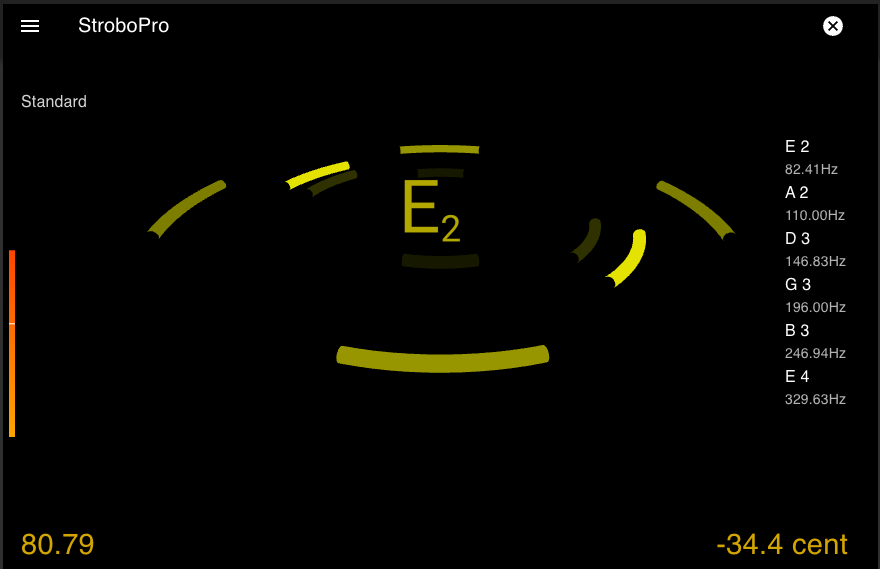
Quick Start Guide
- Allow microphone access: Tap to Tune
- Select your instrument from the dropdown menu (or use Chromatic mode)
- Play a note on your instrument
- Watch the strobe display - when it stops moving, you're in tune!
- Adjust your tuning until the strobes are (mostly) stationary
What is a Strobe Tuner?
Strobe tuners are the most accurate tuners available, used by professional musicians and luthiers to achieve perfect intonation. They work by visualizing the harmonics of your instrument on a patterned display.
Unlike standard needle tuners that only show if you're sharp or flat, strobe tuners show you exactly how far off you are through the speed and direction of the moving display:
- Stationary display = Perfectly in tune
- Clockwise rotation = Sharp (tune down)
- Counter-clockwise rotation = Flat (tune up)
- Faster rotation = Further from the target pitch
StroboPro brings this professional technology to your device, making it accessible and easy to use.
Learn more: For deep dives on strobe tuning, why 0.1 cent accuracy matters, bass and piano tuning, and how to test any tuner's accuracy, visit the StroboPro Blog.
How to Read the StroboPro Display
Fundamental and Harmonics
Most instruments produce not just a single tone but a fundamental tone plus a series of harmonic tones. StroboPro shows these as individual harmonic rings around the display:
- The innermost harmonic ring represents the fundamental tone
- Outer harmonic rings represent harmonics (multiples of the fundamental)
- Brighter harmonic rings indicate stronger harmonics in your instrument's sound
- You can choose how many harmonic rings to display, from 4 up to 10, in Settings (Visible Harmonics). This only changes what you see on screen; tuning accuracy is unaffected. The cents reading is always based on the fundamental and the first few harmonics, no matter how many harmonic rings are shown.
Speed and Position
The rotation of the harmonic rings tells you how close you are to being in tune:
- When perfectly in tune, the harmonic rings will remain stationary
- The speed of rotation indicates how far from the target pitch you are
- For fine tuning, focus on getting the fundamental (innermost harmonic ring) stationary first
Strobe Brightness
The brightness of each harmonic ring indicates the strength of that harmonic in your instrument's sound:
- Brighter harmonic rings = Stronger harmonics
- Fainter harmonic rings = Weaker harmonics
- This helps you identify which harmonics are most prominent in your instrument
Cents and Frequency Display
The cents and frequency display shows:
- The note name being detected
- Cents deviation from that note (up to ±58 cents on the LED bar)
- The exact frequency in Hz
Note: The cents readout is a different measurement (a smoothed cents value) than the strobe's phase rotation... both come from the same detection engine, so minor visual differences between the two are normal. The cents value is always computed from the fundamental plus the first 3 harmonics, regardless of the Visible Harmonics setting. For the most precise tuning, trust the strobe display.
Using Note Lock Functionality
Pro Tip: Note Lock helps you focus on tuning a specific note by focusing the tuner on your selected note and optimizing the frequency range so its harmonics display cleanly.
How Note Lock Works
When you enable Note Lock (on mobile, tap the note name to toggle Note Lock):
- The tuner focuses on your selected note by applying targeted audio filters, and optimizes the frequency range so its harmonics display cleanly
- This makes it easier to tune that specific note without jumping to other notes
- It's especially helpful in noisy environments or with instruments that produce complex harmonics
Pro Tip: Note Lock is a filtering aid, not forced detection:
- If you play a completely different note than the one selected, StroboPro may still detect that note, or it may report the selected note as correct, because the filtering is quite strong
- Note Lock simply helps stabilize detection when you're playing close to the selected note
- Think of it as "focusing" the tuner's attention, not restricting its detection
When to Use Note Lock
- When tuning in noisy environments (like backstage or in a band practice)
- For instruments with complex overtones (like pianos or some wind instruments)
- When methodically working through tuning each string or note
Prev / Next Note Navigation
When a note is locked, use the on-screen ◀ / ▶ buttons to step through adjacent notes without unlocking:
- ◀ (left) button: Lock to the previous note (lower)
- ▶ (right) button: Lock to the next note (higher)
Pro Tip: Methodically tune each string by locking the first string, then tap the ▶ (right) button to advance to the next note without re-locking manually.
When Not to Use Note Lock
- When you need to quickly tune multiple different notes
- If you're unsure which note you're trying to tune to
- When you want to see what note you're actually playing
Fine-Tune with Microphone Sensitivity
StroboPro lets you set the microphone sensitivity (dB) in Advanced settings to suit your instrument and environment. This helps it lock onto the notes you play and ensures accurate tuning without interference from ambient sounds.
If you're experiencing issues with detection:
- Move to a quieter location if possible
- Position your device's microphone closer to your instrument
- Play notes clearly and allow them to sustain
Customizing Your Tuning Experience
Reference Frequency Adjustment
The default reference frequency is A4 = 440Hz, but you can customize this in settings:
- For playing with other musicians who use a different reference
- For historical or period instruments that traditionally use different references
- For personal preference or specific performance requirements
Your chosen reference frequency is automatically saved for your next session.
Note: The Test Tones calibration preset (Test Tones → Calibration) follows your reference frequency. Its targets are defined relative to A4, so at the default A4 = 440 Hz they read exactly as labeled (10, 20, 50, 100, 200, 440, 1000, 2000, 4000 Hz). If you change the reference (say to A4 = 442 Hz), every tone scales with it. Set A4 = 440 Hz if you need the tones to read as absolute Hz.
Transposition
Transposition lets you shift the note NAMES shown on screen. It is useful for transposing instruments, whose written (notated) pitch differs from the pitch that actually sounds. When you set a transposition, StroboPro displays the note name as it would be written on the score rather than the sounding note.
Example: a B♭ clarinet, playing a written C sounds a B♭. Setting the transposition to C→B♭ makes the tuner show the written note (C) instead of the sounding note (B♭).
Set the transposition via the transposition chooser in settings. This is the global transposition control, applied to all tuning modes.
Transposition with Custom / AI Tunings:
When a custom or AI-generated tuning is active, transposition works in "sheet music" mode: the note NAME shown shifts to the written pitch, while the displayed frequency (Hz) stays at the true sounding pitch. So you may see a note label and an Hz value that correspond to different letter names; this is intentional (written name, sounding frequency), and "in tune" still measures the true pitch.
Built-in chromatic tunings handle transposition differently: they shift the tuning reference. This is expected.
Note names use standard letters (A–G with ♯/♭). Custom display symbols you set per note in the tuning editor are not changed by transposition: a symbol is a positional label (a string number, a key name, a paired-course marker), not a pitch name, so transposition shifts the underlying pitch while the symbol stays attached to its note. See Display Symbols below.
Display Symbols (Custom Note Labels)
Every note in a tuning can carry an optional display symbol: a short label that replaces the standard letter name wherever the note is shown. Set it per note in the tuning editor (Edit Note, then "Display Symbol"). Leave it blank to keep the standard note name.
When a note has a symbol, it appears in place of the letter name in:
- The note-lock chips along the side of the strobe.
- The main note readout in the center of the display.
Common uses:
- Stringed instruments: number the strings (1–6 for guitar, 1–4 for bass) so each chip names the string rather than its pitch.
- 12-string and paired courses: mark paired strings with labels like "4+3" or "2+1" to tell the courses apart.
- Custom or experimental tunings: any short label (a key name, a sympathetic-string name, or an arbitrary tag) that matches how you think about the instrument.
Symbols and transposition:
A display symbol is a positional label, not a pitch. Transposition shifts the underlying pitch (and the standard letter name a note would show), but the symbol itself never changes. So a six-string guitar labeled 1–6 keeps those numbers on the same strings whether or not you transpose; only the pitch each string is tuned to moves. The "in tune" measurement is always against the true sounded pitch.
Instrument Selection and Tunings
StroboPro supports various instrument-specific tunings to match your needs:
- Select your instrument type from the dropdown menu
- Choose from various tuning presets for your instrument
- Each instrument has special offsets to ensure accurate tuning
Pro Tip: Some tunings (e.g. piano stretch, True Temperament) include per-note cents offsets baked into the tuning definition.
Save Your Settings Across Devices Free on web Premium on mobile
With sign-in on the web (Google, Apple, or email) (or, on mobile, a pro version plus Google/Apple Login), you can access your custom settings on any device:
- Your custom instruments and tunings
- Reference frequency preferences
This ensures a consistent tuning experience no matter where you play.
Note: Custom tunings you create while signed out are stored only on this device and will not sync to your other devices. To keep your custom tunings available everywhere, sign in before creating them. Signing out returns the app to its default instrument set; your synced tunings reload automatically the next time you sign in.
Record Mode: Create Custom Tunings Easily Free on web Premium on mobile
Record mode makes creating custom instrument tunings simple:
- Select "Add Instrument" and enable Record mode
- Play each string/note of your instrument one at a time
- StroboPro automatically detects and saves each note
- Name and save your custom instrument tuning
Pro Tip: When creating a new custom tuning, StroboPro automatically inherits the notes from the first existing tuning under that same instrument and sub-instrument combination to give you a helpful baseline starting point. If the category has no existing tunings yet, it will initialize with a single reference note (A4), which you can then customize or generate over using AI.
Piano Tuning Assistant Mobile Premium
The Piano Tuning Assistant (PTA) is a guided wizard (mobile app feature) that creates a custom tuning tailored to your specific piano. Every piano is a little different; the thickness and length of its strings affect how the notes sound together. The PTA listens to your piano, learns how its strings behave, and builds a tuning that makes your piano sound its best.
Why Pianos Need Special Tuning
On most instruments, a perfectly tuned note has overtones (the "ring" of the note) that line up neatly with other notes. Piano strings are thick and stiff, which pushes these overtones slightly sharp, especially in the bass and the highest treble.
If you tune a piano to a standard chromatic tuner, it won't sound right; the notes will clash when you play chords. Professional piano tuners solve this by "stretching" the tuning: tuning high notes a bit sharp and low notes a bit flat, so everything sounds in tune with itself. The PTA does this automatically, based on measurements from your actual piano.
Using the Piano Tuning Assistant
The wizard walks you through five steps:
Step 1: Setup
Select your piano type (Spinet, Console, Upright, Baby Grand, Studio Grand, Concert Grand, or Other). This helps the wizard set sensible defaults. Then choose an octave style; this controls how aggressively the tuning is stretched:
- 4:2 octave: The standard choice. A good balance for most pianos.
- 6:3 octave: A wider stretch. Some tuners prefer this in the bass.
- Pure 12ths: Stretches so octaves + fifths are pure. Popular in modern tuning.
- Concert grand: Optimized for large grand pianos.
If you're not sure which to pick, go with 4:2; it works well for most pianos.
Step 2: Bridge Break
Tell the wizard where the thick, wound bass strings end and the plain wire strings begin. The app suggests a default based on your piano type; adjust it if needed. This helps the stretch curve transition smoothly between the bass and treble sections.
Step 3: Measure
The wizard asks you to play a few sample notes across the keyboard. For each one, the app listens to how the note rings and measures how much its overtones stretch.
- The app locks onto the sample note
- Play the note and let it ring out
- The app records the measurement
You need at least 3 successful measurements to generate a tuning. The more you measure, the better the result.
Pro Tip: For the best measurements:
- Play each note at a moderate, consistent volume
- Let the note ring until the app confirms it got the measurement
- Keep the room quiet: no TV, other instruments, or conversation
- If a measurement looks wrong, just redo it
Step 4: Review
Review the generated stretch curve. It shows how many cents (hundredths of a semitone) each note will be offset from standard tuning. You'll typically see the low bass tuned a bit flat and the high treble tuned a bit sharp; this is normal and correct.
Step 5: Apply
Apply the custom tuning. It's saved as a new instrument in your list. When you tune each note, the strobe display targets the stretched frequency, so you just tune until the strobe stops moving, and your piano will sound great.
Predefined Piano Presets
Don't want to measure? StroboPro includes ready-made stretch presets for common piano types: Spinet, Console, Upright, and several Grand sizes. These presets now include baked-in inharmonicity data for each note, ensuring that the strobe and detection engines are optimized for that piano type from the moment you start.
For acoustic pianos, the Mixed 6:3 / 4:2 Octave style is highly recommended. It aligns the 6:3 partials in the bass register (through B2) for a rich, clear bass, and switches to 4:2 partial alignment in the middle and treble registers for clean octaves without beating.
Important: The inharmonicity B-coefficients belong to the Sub-Instrument subtype (the physical model), not to the individual cents tuning presets. When you use the Save As feature, the cents are copied to the new tuning, but the inharmonicity B-coefficients are supplied by whichever destination piano type you select. A newly created custom subtype has no default B-coefficients; you should select an existing factory piano type, or create a custom profile using the Piano Tuning Assistant on mobile.
Known limitation: The factory B-coefficient profiles for smaller piano types (Upright, Console, Spinet) produce more stretch than reference data from measured pianos. For Concert Grand and Studio Grand the factory presets are accurate. For smaller piano types, using the Piano Tuning Assistant to measure your actual piano will give significantly better results than relying on the factory presets.
How the Strobe Adapts to Your Piano
When you use a piano tuning (measured or preset), StroboPro automatically adjusts the strobe display to account for how your piano's strings actually ring. Each harmonic ring on the strobe aligns to the real overtone positions, using the inharmonicity B coefficients associated with the active piano subtype definition. This ensures the display reads clean and steady across all partials. This works in both chromatic (auto-detect) mode and with Note Lock, no extra steps needed.
Advanced Topics
Using StroboPro for Intonation Adjustment
Intonation is how well your instrument plays in tune across its entire range. Poor intonation means that even if individual strings are in tune, chords will sound out of tune in different positions.
For Electric and Acoustic Guitars
- Prepare your instrument: First tune all strings to their correct pitch
- Check open string: Play an open string and ensure it's in tune
- Check 12th fret harmonic: Lightly touch the string directly above the 12th fret and pluck
- Check 12th fret fretted note: Press the string down at the 12th fret and pluck
- Compare: The harmonic and fretted note should both be in tune (stationary strobe)
- Adjust: If the fretted note is sharp (clockwise motion), move the saddle away from the neck; if flat (counter-clockwise), move it toward the neck
- Repeat: Re-tune the open string and check again until both match
- Repeat for all strings: Follow the same process for each string
For Other Stringed Instruments
Similar principles apply to other stringed instruments, though adjustment methods vary by instrument type. The key is checking that notes played at specific intervals (like octaves) remain consistently in tune across the instrument's range.
Using StroboPro for Ensemble Tuning
When tuning multiple instruments to play together:
- Establish a reference: Choose one well-tuned instrument as your ensemble reference
- Match reference frequency: Ensure all StroboPro instances use the same reference frequency (e.g., A4=442Hz)
- Tune in order: Start with bass instruments, then mid-range, then high-range
- Check intervals: Play intervals between instruments (octaves, fifths) and ensure they sound consonant
- Final check: Play a simple chord progression with all instruments to confirm ensemble tuning
This methodical approach ensures your ensemble will sound harmonious across all registers and instruments.
Frequency Range & Auto-Decimation
StroboPro uses audio decimation to maximize frequency resolution. When Note Lock is active, the app automatically selects the optimal frequency range based on the locked note, no manual adjustment needed.
How It Works
- Default: Best frequency resolution for bass, guitar, and most stringed instruments
- Higher: Extends the display for instruments with higher harmonics
- Highest: Covers the entire frequency spectrum for very high notes
Pro Tip: StroboPro automatically selects the optimal frequency range when you lock a note, no manual adjustment needed. If you notice harmonics disappearing from the strobe display while in chromatic (unlocked) mode, lock to the note and StroboPro will auto-select the correct range.
FFT Size Mobile Premium
The FFT size controls the trade-off between frequency accuracy and responsiveness in note detection. Larger sizes give more accurate results but have more latency; smaller sizes are faster but less accurate. If StroboPro is misidentifying the note you're playing, try a different size. The default is 2048 - this seems to be the best tradeoff. Note that FFT size is NOT used to measure the tuning of your instrument, only to lock the strobes to the correct note and overtones.
- 1024: Fastest, least precise
- 2048: Balanced (default)
- 4096: Most accurate, highest latency
Strobe Display Type Mobile Premium
Chooses how the strobes are animated. Velocity (default) measures the strobe's current speed and animates at whatever frame rate your device can sustain. Position samples the current position and snaps the strobe to it, more like a real strobe tuner, but only works well on faster devices.
Strobe Refresh Rate Mobile Premium
Controls how often the app measures strobe velocity. The strobes run continuously in the background, and the measured velocity is mirrored in the on-screen animation. Higher rates capture velocity changes faster but may reduce precision; lower rates are more stable but less responsive. The default is 80 Hz.
- 30 / 40 Hz: Most stable, least responsive
- 60 / 80 Hz: Balanced (80 is default)
- 100 / 120 Hz: Most responsive, may reduce precision
Glow Effects Mobile
A purely cosmetic toggle that adds a soft glow to the strobe display for extra visual polish. It is not a premium feature, but it may slow down the app on older devices; turn it off if the animation feels sluggish. Off by default.
Tuning in Noisy Environments
StroboPro is designed to work well even in challenging acoustic environments:
Tips for Better Results
- Use Note Lock: Lock to your target note to reduce note-jumping
- Position your device: Place your device close to your instrument's sound source
- Isolate your instrument: Try to find a quieter corner or use your body to shield the microphone from other sounds
- Sustain notes longer: Allow each note to ring out clearly for better detection
Troubleshooting Tips
| Issue | Possible Solutions |
|---|---|
| No sound detected |
|
| Display jumping between different notes |
|
| App crashes or freezes |
|
| Tuning seems inaccurate |
|
| I can't see custom tunings that I have created on strobopro.se |
|
Frequently Asked Questions
How do I use StroboPro strobe tuner?
Allow microphone access, select your instrument, play a note. The harmonic rings stop spinning when you are perfectly in tune.
Why is my tuner not hearing anything?
Ensure you have allowed microphone access. If using a Bluetooth headset, try disconnecting it. Try restarting your browser or switching to Chrome or Firefox.
What is a strobe tuner and why is it more accurate?
A strobe tuner displays the phase difference between the input signal and a reference frequency in real time. This provides 0.1 cent accuracy with zero latency, compared to 1-3 cents for typical needle tuners.
Is StroboPro free?
Yes. StroboPro is free to use on the web at strobopro.se, where ads support our costs. The mobile app is ad-free and offers additional premium features via subscription.
What instruments does StroboPro support?
StroboPro supports guitar, bass guitar (4-6 string), mandolin, upright bass, piano, ukulele, banjo, nyckelharpa, violin, and any other instrument via custom, user-defined or AI-generated tunings. You can share your tunings with others via the share button.
Is StroboPro available on iOS and Android?
Yes. StroboPro is available as an iOS and Android app with additional premium features including Pitch Pipe and the Piano Tuning Assistant. AI Tuning is a premium feature available to signed-in users on both the web app and the mobile app. The web version at strobopro.se is free to use; the mobile app is ad-free and supported by premium purchases.
What is the Piano Tuning Assistant?
The Piano Tuning Assistant is a guided wizard (premium mobile app feature) that listens to your piano and builds a custom stretch tuning, so chords sound in tune with themselves across the whole keyboard.
How can I combine a reference stretch with my piano type?
To combine a reference stretch with a specific piano type:
- Select Piano → Reference Stretches and choose the desired curve.
- Select Edit Tuning, then Save As.
- Choose Piano and select an existing destination type, such as Concert Grand, Studio Grand, Upright, or Spinet.
- Enter a unique tuning name and save it.
- Select the saved tuning under that piano type.
The Save As action copies the reference cents while the destination subtype supplies its per-note inharmonicity coefficients. Note that a newly created subtype has no default coefficients: users must choose an existing factory piano type or an existing Piano Tuning Assistant profile. Note that factory B-coefficients are generalized approximations; for an actual piano, using the Piano Tuning Assistant to measure the real strings is highly recommended and will yield a significantly better result.
Mobile App Premium Features
The StroboPro mobile app includes additional premium features. AI Tuning is a premium feature available on both the web app (for signed-in users) and the mobile app; Pitch Pipe, Echo Mode, and the Piano Tuning Assistant are mobile-app premium features.
AI Tuning Generation Premium
Experience the future of tuning. Simply describe any setup in plain English, from "Drop D tuning" and "Open G" to "Custom 7-string for death metal", and our AI will generate it instantly for you. No more manual entry; just describe and tune.
What It Supports
- Any standard or alternative tuning (Drop D, Open G, DADGAD, etc.)
- True Temperament tunings
- Custom instruments and exotic tunings
- Anything in your imagination (you can always modify the tuning that the AI gives you, or ask it for changes)
How to Access
AI Tuning is a premium feature available on both the web app (for signed-in users) and the mobile app. You can also define and save custom tunings on strobopro.se for free.
Pitch Pipe Mobile Premium
Get perfect reference tones with studio-quality audio, generated in real-time. Our pitch pipe features smooth fade-in and fade-out so you can start and stop tones silently - no clicks or pops during performances. Ideal for a cappella groups, choir directors, and musicians who need reliable reference pitches.
How to Use the Pitch Pipe
- Tap the Pitch Pipe icon in the toolbar
- Select the note you want to hear
- Adjust amplitude as needed for your environment
- Tap the note again to stop (smooth fade-out prevents clicks)
Pro Tip: The pitch pipe is especially useful for:
- A cappella groups setting their starting pitch
- Choir directors giving reference notes to sections
- Musicians tuning by ear in situations where visual tuning isn't possible
- Educational settings for teaching relative pitch
Echo Mode (Accessibility) Mobile Premium
Echo Mode provides audio-first tuning guidance for visually impaired users. Instead of reading the strobe display, you hear a reference tone that guides you to the correct pitch.
How to Use Echo Mode
- Enable Echo Mode in Settings
- Once enabled, the app continuously listens for your instrument
- When a stable pitch is detected, the app plays a tone that glides from your instrument's pitch to the target pitch
- The tone holds at the target pitch, then fades out
- After a brief hold-off pause (to prevent the app from hearing its own tone), the listening cycle repeats automatically
- Tune your instrument to match the held tone; the cycle will continue guiding you until you stop Echo Mode
Echo Mode uses sensible default durations (min note, glide, hold, hold-off) tuned for typical use.
Pro Tip: For best results with Echo Mode:
- Echo mode automatically finds the nearest note to guide you to the correct target
- The glide range is limited to ±100 cents. If your instrument is further off, play closer to the desired note
- The hold-off period prevents the app from hearing its own reference tone and confusing it with your instrument
- Screen reader announcements are provided for status changes
StroboPro is now on iOS and Android!
Related tuning guides
- Best free online strobe tuner
- Best guitar tuner app
- Best bass tuner
- Best piano tuner
- Best tuner for intonation
- 0.1 cent accuracy explained
